x
Mostrando entradas con la etiqueta infographic. Mostrar todas las entradas

sábado, 9 de mayo de 2015

21st Century Teens Vs 20th Century Teens

May 9, 2015
Technology has had such a huge transformative impact on teen’s behaviour and subsequently their lifestyles. One example in favour of this transformation is social networking. Before the massive uptake of Internet and web 2.0 technologies, kids at the time used to socialize with friends from school or neighbourhood and they got to spend time together in  “real world”. Now, virtuality takes over and platforms such as Facebook, Snapchat, online gaming sites…etc have redefined the notion of social networking unleashing it from the spatio-temporal boundaries that used to stand in the face of people getting to know and talk to each other.

In this beautiful infographic, the folks in TeenSafe mapped out teens' changing behaviour over the last 20 years. They have particularly focused on the social aspect of teen’s lives and have revealed some really astounding stats about the increasing dependence of teenagers on social media  as the primary means of socialization. Read on to learn more

Teens social media impact
Courtesy of Makeuseof

miércoles, 6 de mayo de 2015

12 Mobile Learning Trends to Watch Out For in 2015

May 7, 2015
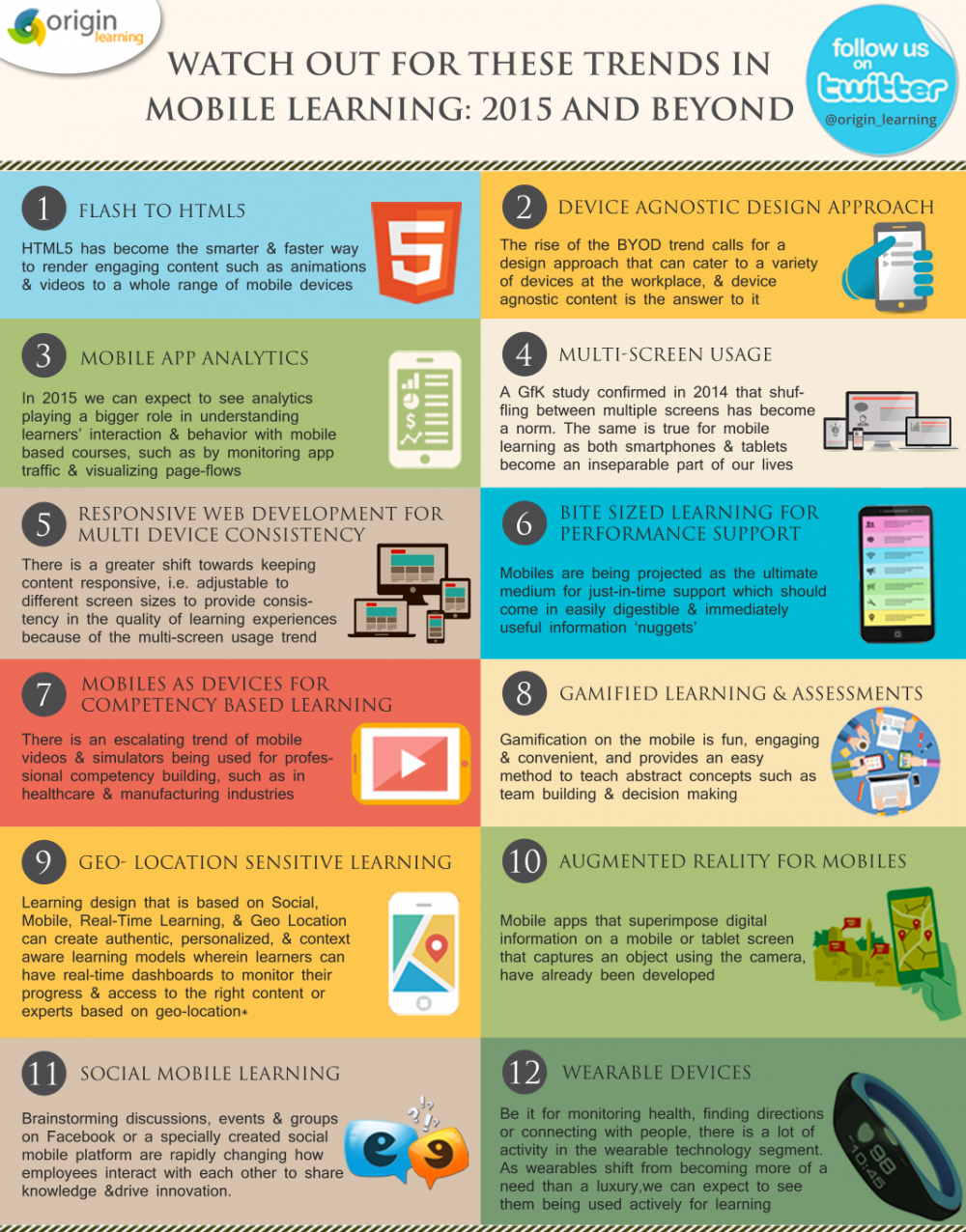
We are at the juncture of a monumental period in the history of education where mobile technologies are driving learning.With the growing use of hand-held mobile devices and broad band Internet connection,  mobile learning has become ubiquitous practice. With raise of on-the-go learning, there emerged a range of promising learning trends that address different learning and instructional needs. This beautiful visual from Original Learning provides a succinct overview of some of the most popular mobile learning trends to watch out for in this year and beyond. Some of which include:
  • Flash to HTML5
  • Device agnostic design approach
  • Mobile app analytics
  • Multi-screen usage
  • Responsive web development for multi device consistency
  • Bite sized learning for performance support
  • Mobiles as devices for competency based learning
  • Gamified mobile learning and assessments
  • Geo-Location sensitive learning
  • Augmented Reality for mobiles
  • Social mobile learning
  • Wearable devices
productivity tips Courtesy of: eLearning Infographics

Follow us on : Twitter, Facebook , Google plus, Pinterest .

miércoles, 29 de abril de 2015

Experiential Learning Visually Explained for Teachers

April 29, 2015
Experiential learning was the first form of learning through which our ancient ancestors discovered and made sense of the wild world around them. The antiquity of the concept is captured eloquently in several ancient adages. Confucius once said ”tell me and I forget; show me and I may remember, and involve me and I will understand”. Similarly, the revered Greek philosopher Aristotle was quoted saying “for the things we have to learn before we can do them, we learn by doing them”.

The premise underlying experiential learning is that of learning by doing. One of the popular 20th century educationists who wrote prolifically on this concept is John Dewey. In both " Democracy and Education" and  "Experience and Education", Dewey mapped out the major precepts underlying experiential learning. He particularly focused on engaging students in what he called ‘educative experiences’. These are experiences through which students get to connect their past learning with their present situation to speculate scenarios  for future learning situations. According to Dewey, students learn best through hands-on activities and through direct engagement with the learning experience at hand.

Building on Dewey’s work , David Kolb conceptualized an experiential learning theory composed of four cyclical stages: activity and practice, review and reflections, theories and concepts, applications and case studies. Reality Works has this wonderful free visual with more insights on Kolb’s theory together with some interesting nuggets on what experiential learning is all about.

Check it out the full graphic from this page. Enjoy


martes, 28 de abril de 2015

A Beautiful Visual On The Impact of Technology on Today's Classrooms

April 28, 2015
We just came across this beautiful visual on the impact of technology on classroom learning and teaching and wanted to pass along some important stats that stood out to us. Technology is radically transforming the education landscape and the stats below speak volumes to this transformation:


In a 2009 report released by the National Centre for Education  Statistics with the Department of Education:74% of Pre-K to 12th grade teachers said that technology has helped them reinforce and expand content and has also motivated students to learn. 73% of these teachers also reported that technology enables them to respond to a variety of learning styles and allows them to demonstrate things that could not demonstrated otherwise.

Impact of technology on student writing:
A larger majority of teachers attest to the positive influence of web technologies on students writing. For instance, 96% view that technology helped students share their work with a wider and more varied audience. Another 79% agree that digital technologies encourage wider collaboration among students and boost student creativity and personal expression.

Impact of technology on homework
Technology has also transformed the way students do their homework. For instance, 31% of students report using  a tablet to do their homework, another category that amounts to 65% say they use laptops for homework while 39% of 11 to 14  years olds use smartphones for homework.

Read on to learn more about how technology impacts education in areas such as flipped classroom, mobile learning and many more. Enjoy

productivity tips
Via University of Cincinnati
Courtesy of eLearning Infographics

sábado, 25 de abril de 2015

A Beautiful Graphic On Bad Digital Habits

April 26, 2015
In the midst of this digital hype and the ubiquity of technology, one should pause for an instant and reflect deeply on the implications of being constantly connected. More specifically, the implications of connectivity on our social, cultural, intellectual and emotional well-being. Important as it is but the question here is not about how much time we spend interacting with  technology but rather how are we using it and to what benefits? Asking questions such as these is supposed to trigger your critical awareness regarding the different ways you use your time and consequently enable you to make the best of your time.


In the process of our interaction with technology, we get to develop a set of habits that we keep doing almost every day (e.g checking emails, social media websites…etc); however some of these habits get so grounded in our daily practice that they become addictive.This is especially the case with those who spend tremendous amount of time playing online games or those who are obsessed with sharing with others on social media every bit of their lived experiences. The visual below from StudyWeb features some examples of bad digital habits created by Internet. Apart from number 5 which we think does not apply to us as educators and teachers, all of the other habits are really worth some serious meditation. We invite you to check them out and, as always, share with us what you think of them. Enjoy

productivity tips
Courtesy of Make Use Of.

viernes, 17 de abril de 2015

10 Essential Skills for The 21st Century Worker/ Learner

April 18, 2015
Here is an interesting infographic from university of Phoenix featuring 10 essential skills for the successful worker.Going through the list we remarked that these skills are important not only for a successful work for successful learners as well. In fact, these skills represent the ethos of the 21st century epoch, an era where knowledge economy and the social capital are so interdependently connected that it becomes extremely hard to decipher the dividing line between the two.

The top 10 skills for the 21st century worker, according this visual, include:

  • Critical thinking
  • Leadership
  • Communication
  • Collaboration
  • Adaptability
  • Innovation
  • Global citizenship
  • Productivity and accountability
  • Enterpreneurialism
  • Accessing and synthesizing information

Check out the full visual from this page.


lunes, 13 de abril de 2015

The Four Popular Learning Evaluation Models

April 14, 2015
Evaluation is a central component of the learning process without which we would not be able to gauge learning objectives and identify learning needs. The instructional process as a whole is informed and guided (at least that’s how it should be) by results gleaned from evaluative procedures. There are actually different evaluation models out there, the infographic below, features 4 of the most popular among them. The one that stands out to us from the list is Kirkpatrick’s model of training and education. This model is composed of four major levels:
  • Level Four−Results: To what degree targeted outcomes occur, as a result of learning event(s) and subsequent reinforcement.
  • Level Three−Behaviour: To what degree participants apply what they learned during training when they are back on the job and attitudes based on their participation in the learning event
  • Level Two−Learning: To what degree participants acquire the intended knowledge, skills.
  • Level One−Reaction: To what degree participants react favourably to the learning event.
Read on to learn more about the other three evaluation models.

Popular learning evaluation models
Via: Reed learning
Courtesy of : eLearning Infographics

Follow us on : Twitter, Facebook , Google plus, Pinterest .

domingo, 12 de abril de 2015

A Beautiful Visual on The Impact of Music Education on Kids Cognitive Skills

April 12, 2015
Does music  education really improve kids cognitive skills? The answer, in our view, is hard to determine and it requires a series of longitudinal studies across different cultural and ethnic groups. However, certain small-scale studies such as the ones cited in the visual below do provide a preliminary evidence in favour of the correlation between taking music lessons and improvement in certain cognitive skills. For instance, in a study of 96 children aged 5-7 years old, those who received 7 months of supplementary music and arts classes earned higher mathematics scores than those with the schools’ typical music and arts training. In another collection of studies that involved a larger base of participants from high schools, researchers were able to identify a strong correlation between music instruction and higher reading test scores.

Always according to this infographic, music education was behind the blossoming of some great creative minds in the history of humankind (i.e Leonardo da Vinci, Issac Newton, Thomas Edison, Galileo Galilei and many mothers). More specifically, the visual cites six key areas positively impacted by music education: math skills, reading skills, memory, IQ, SAT scores, and planning. Read on to learn more about how music education improves human cognition.
impact of music education on kids cognitive skills  Via: Take Lessons
Courtesy of: eLearning Infographics

domingo, 5 de abril de 2015

A Beautiful Graphic On The Evolution of Classroom Technology

April 6, 2015
The history of educational technology is an eventful timeline full of amazing breakthroughs that have radically transformed the educational landscape and reshaped the basic notions of literacy and learning. However, if you sit back and reflect upon these developments in their relation to education, you will notice that the first decade of the 21st century alone witnessed a digital revolution that is unprecedented both in breadth and grandeur and with it comes the emergence of new learning concepts such as MOOCs, flipped learning, mobile learning, to mention but a few.

Also the number of technological inventions in the last couple of decades alone outnumber all inventions during the past three centuries. The train of technological breakthrough is still moving but now it is moving at spectacular speed to the extent that we can not even expect what the EdTech world has in store for in the few upcoming years.

Here is a nice graphic that captures some of the major technological events in the history of educational technology. Check it out and share with us what you think of it.

miércoles, 25 de marzo de 2015

A Beautiful Graphic on Emotional Intelligence

March 25, 2015
In the midst of this digital hype instigated by social media and web technologies, much of the  concern and discussion emanating from education community is centrally focused on the digital and technical skills required for thriving in a knowledge economy.Unarguably, digitality is an important part of our students' lives and knowing how to handle it is definitely a pressing requirement, but there are also more important areas that students need to attend to in order to maintain a balanced individual growth. One of them is the emotional part.

In their popular report entitled the Learning Curve, Pearson features emotional intelligence among the the top 8 skills the world is looking for. Similarly, in his classic book Emotional Intelligence:Why It Can Matter More Than IQ, psychologist Daniel Goleman provided a convincing account backed up with a variety of scientific studies highlighting the importance of emotional intelligence in our life . To better understand what emotional intelligence is all about and why it deserves much more attention from us, University of Maryland Online MBA has this excellent graphic to share with you.

productivity tips

sábado, 21 de marzo de 2015

Tips to Engage 21st Century Students

March 8, 2015
Getting students engaged is not an easy task particularly in an age that is full of all kinds of distractions. Some argue that some of the habits that students have developed as a result of their heavy use of emerging technologies and social media have negatively impacted their capacities to concentrate and focus for longer stretches of time. Multitasking in particular is blamed for this and we do side with the camp that views multitasking as a distractor to productivity and not a positive attribute.

Yes multitaskers are hard to hook in and keep their focus on a learning task for longer time but motivation makes a difference. When students are motivated to learn, focus and attention comes along easily. Below is a beautiful graphic featuring 8 ways to get students motivated. Check it out and share with us what you think of it.

miércoles, 18 de marzo de 2015

A Beautiful Timeline on The History of Education

March 18, 2015
The technology of writing is one of the most momentous inventions in the human history. With writing comes literacy and the raise of modern sciences. Compared to orality, writing is a very recent development in the human history. According to Walter Ong (author of Orality and Literacy), Homo Sapiens have been around between 50 or 60.000 years ago and the first script was invented only 6000 years ago. Of course, people have been carving shapes on stones, creating notches on sticks and making markings on rocks for many millennia but these are only semiotic markings that can not be considered writing(always according to Ong and several other literacy scholars including Havelock, Scribble and many others). Writing in the sense of script or coded system was invented by Semitic people around 6000 years ago. As a script, writing includes several systems most important of which is alphabets.


That was a very succinct snapshot of the very beginnings of what is now known as literacy, for those of you interested in learning more about the history of literacy and how it developed throughout the years, we would highly recommend Ong’s classic book “Orality and Literacy”. In similar vein, we also have for you this beautiful visual timeline that chronicles the major epochs that marked the history of education. Check it out below. This visual is created by Boundless.


A Beautiful Timeline on The History of Education
Courtesy of eLearning Infographics

lunes, 16 de marzo de 2015

Do you Know about These 7 Learning Zones in Your Class?

March 17, 2015
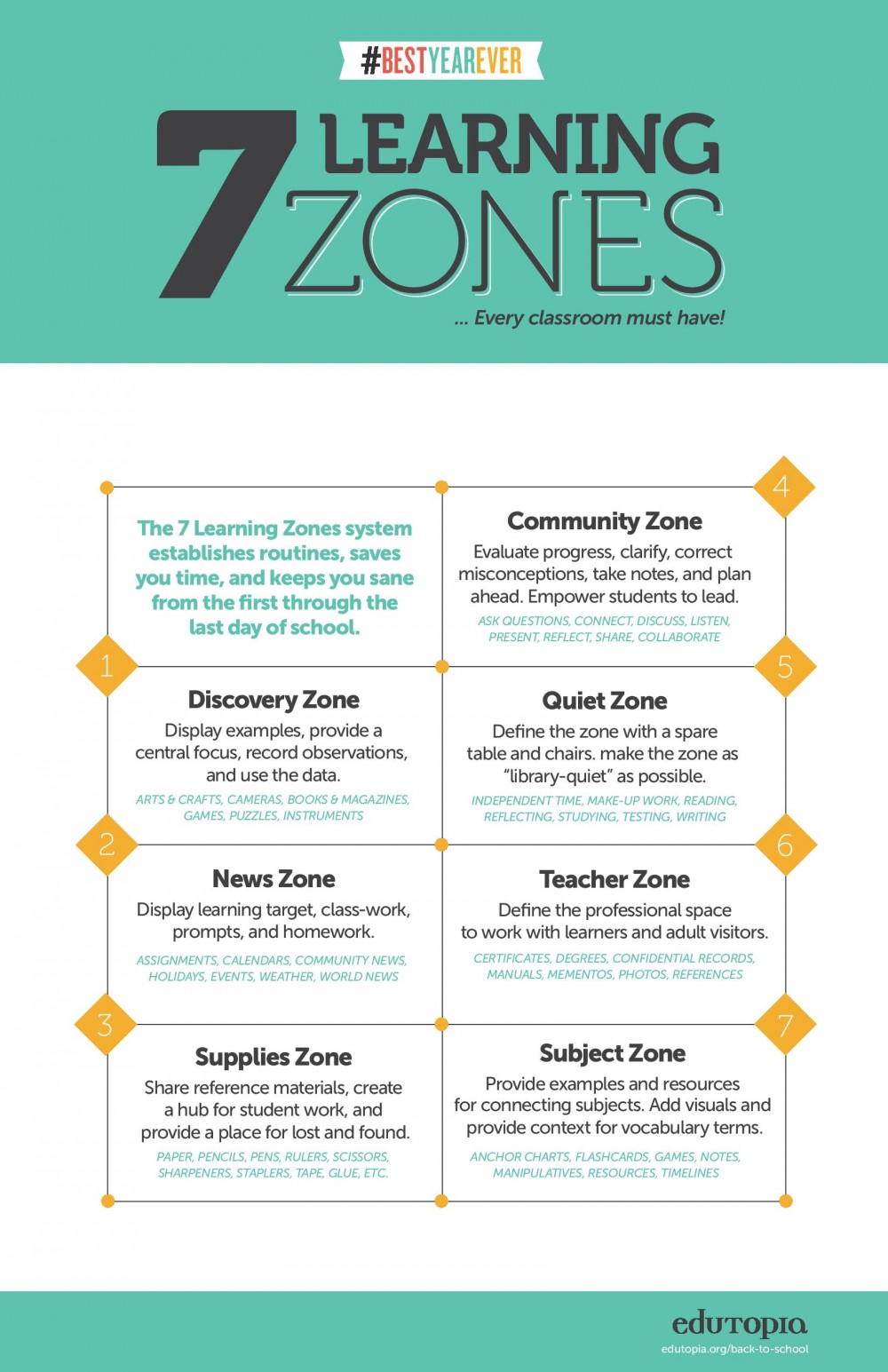
7 Learning Zones is a beautiful visual created by Edutopia featuring an interesting system teachers can use in their classrooms to organize and manage students learning experiences. This system is composed of 7 zones, each zone targets a specific area in the instructional process and suggests some examples of what it is designed for.

The 7 zones included in this visual are :

1-Discovery Zone:
This one is for providing a central focus, sharing examples. recording observations and using the data.
2- News Zone:
This is for displaying the learning targets, managing class-work and homework.
3-Supplies Zone: 
This one is for sharing reference materials, creating hubs for students work, and providing a place for lost and found.
4- Community Zone:
This is for assessing progress, clarifying and correcting misconceptions taking notes and planning ahead.
5- Quiet Zone:
This is a place for quiet zone for reflecting, reading and writing and studying
6- Teacher Zone: This is to help you define the professional space to work with learners and adult visitors.
7- Subject Zone: 
This last zone is for providing examples and resources for connecting subjects.

7 Learning zones
Courtesy of eLearning Infographics

Follow us on : Twitter, Facebook , Google plus, Pinterest .

sábado, 14 de marzo de 2015

A Beautiful Visual on How Technology Is Transforming 21st Century Education

March 14, 2015
Technology is radically transforming the education landscape.The technological innovations and digital progress that marked the last two decades have brought a massive change in the ways education is being conceptualized and delivered, bigger than anytime in the history of mankind. Pessimists would call it technological determinism but we see it as a new window of opportunity into the vast horizon of learning.

According to “Bringing Our Schools into The 21st Century Infographic”, some of the opportunities provided by technology for education include:
  • High speed connectivity which will enable a wider access to the net
  • Cloud based storage capabilities which will, among others, help develop a professional educational culture, enhance communication and improve knowledge sharing.
  • Digital portfolios will be commonplace among students. They will be heavily used to demonstrate knowledge and showcase achievements
  • Game-based learning will be incorporated into the 21st century learning on a larger scale.More students will be using learning designs integrated in games to practice and improve their problem-solving skills and creative thinking competencies.
Read on to learn more about the opportunities technology opens for the 21st century education
Opportunities afforded by Technology for 21st Century Education  Via Teachers Degrees
Courtesy of eLearning inforagphics

jueves, 5 de marzo de 2015

A Beautiful Visual Explanation of Hashtags

March 6, 2015
Hashtags are social networking phenomena par excellence. They originated in Twitter a around 2008 and since then they adopted and integrated into many other popular social platforms such as Facebook, Google Plus, and Instagram. We have already shared several posts covering the educational potential of hashtags, most popular among them all is teachers’ simple guide on the use of hashtags.

Today we are sharing with you this beautiful visual  we discovered through a tweet from Tom D’Amico. This visual, which is created by Quick Sprout and initially shared on The Seen, provides a very good explanation of what the concept of hashtaging is all about and how it works in different social media websites such as Instagram, Twitter, Facebook and Google Plus. We invite you to have a look and as always share with us what you think of this work.

Ultimate Guide on Hashtag

jueves, 26 de febrero de 2015

A Beautiful Classroom Poster On Steps for Good Writing

February 27, 2015
5 Steps to Writing A Poem is a visual created by  Cambridge University and outlines the 5 major stages to composing a poem. In fact, the steps mentioned here are generic and can be used for writing any other genre, of course with a bit of tweaking. As a teacher you might want to share this work with your students and guide them through the different stages they need to follow to produce a good piece of prose or poetry.

The 5 steps featured in this visual are : inspiration (some basic techniques for generating inspiration and ideas to write about), Brainstorm (mapping out ideas), Form and Style (raise students consciousness to the different styles out there), Word Choice (use of language and vocabulary), Five Sense (engage your senses to create and imagine scenarios for your ideas and writing).


The visual is available in PDF format that you can download for free and use with your students. Here is the download link. Click HERE to see and download the original poster.

martes, 24 de febrero de 2015

A Beautiful Visual Featuring The 7 Cs of Effective Communication

February 24, 2015
Following the post we shared here a few weeks ago featuring some useful resources to help teachers and educators master the art of presenting, somebody sent us this beautiful visual which ties in with the theme of that post. 7 Cs of Effective Communication is a work from Brainy Quote and Evan Carmichael. The visual  outlines some interesting strategies to keep in mind when delivering a talk, facing an audience, or conversing with others. Communicative competence is at the core of the skills we need as teachers and it is also the key to a better mutual understanding. We are hoping the visual will provide you with a refresher on some of the effective ways to maintain effective communication. Have a look and share with us what you think of this work.

Check the original graphic from this page.

communication tips


lunes, 23 de febrero de 2015

27 Reflection Strategies to Improve Your Teaching

February 23, 2015
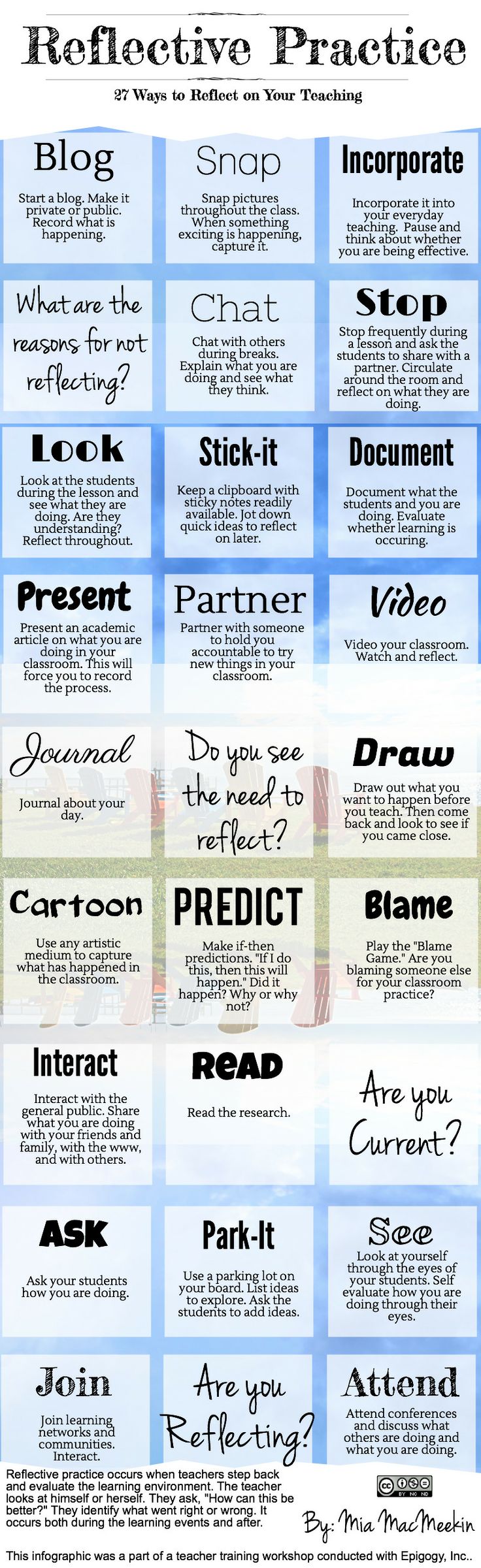
Reflection and reflexivity are two meta-cognitive processes that we constantly need to exercise in order to guarantee an effective and healthy professional and also emotional growth. Unless you take a pause and think deeply about what you are doing and how you are doing it, you will never get to learn about your weaknesses and strengths. You won’t be able to stop navel-gazing and see the whole picture from an onlooker perspective.

As a teacher, there are several ways and strategies to employ to cultivate a reflective mindset and enhance your self-evaluative practices. Some of these strategies are beautifully captured in the visual below created by Mia MacMeekin from Anethicalisland. We invite you to go through them and share with us what you think of this work. Enjoy

27 Ways to Reflect on Your Teaching  Follow us on : Twitter, Facebook , Google plus, Pinterest .

martes, 17 de febrero de 2015

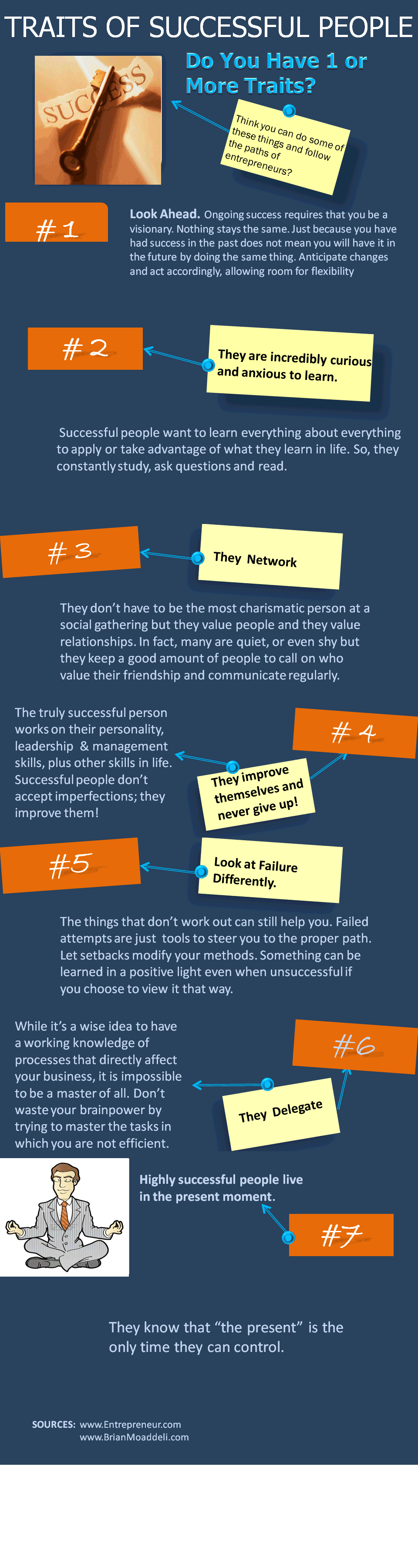
The 7 Attributes of Successful People

January 17, 2015
Traits of Successful People is an interesting visual that delves deep into the  mindset of those who have embraced success in their lives. Setting aside the definitional problematic of success (for success can mean different things to different people) we can all probably convene on the idea that successful individuals do have many things in common at least on the conceptual level. For instance, successful people tend to have an open aptitude towards mistakes and view them as precursors of good learning. And while they live in the present, successful people always anticipate and prepare for the future. They are flexible enough to adapt to change and are willing to constantly learn from others. These and several other traits make up the mindset of successful people as shown in the graphic below.

Check out the full visual from  Loveinfographics 

Traits of Successful People

Follow us on : Twitter, Facebook , Google plus, Pinterest .

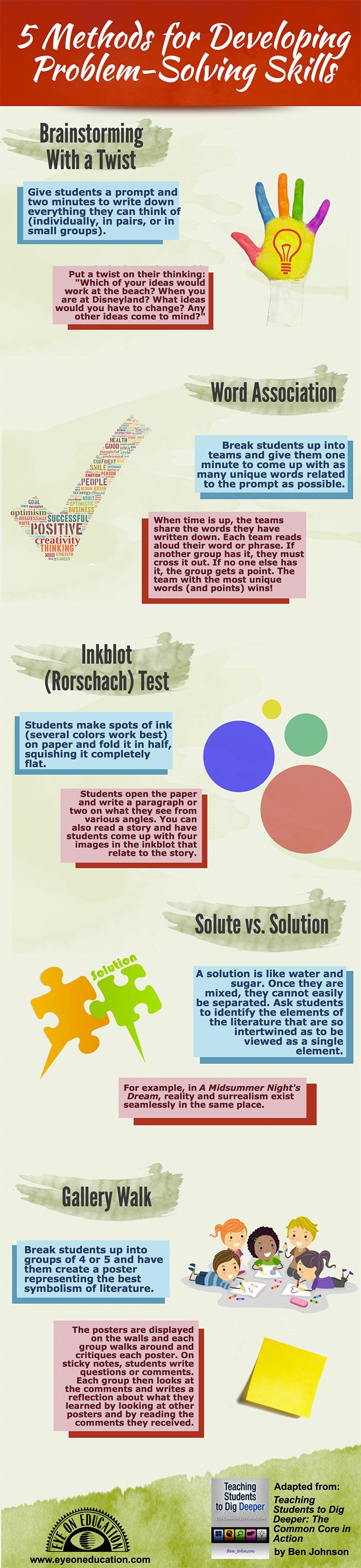
5 Effective Ways for Developing Problem Solving Skills

February 17, 2015
Here is a wonderful visual from Eye on Education featuring 5 methods for developing problem-solving skills. This work is adapted from Ben Johnson’s book “ Teaching Students to Dig Deeper; The Common Core in Action”. The methods advocated here include: brainstorming, word association, Inkblot test, solute vs solution, gallery walk. Each of these methods is explained and illustrated with examples on how to use it with your students. I invite you to check it out and share with us what you think of it . Enjoy

Check out the full graphic from this page

Problem solving strategies